I’ve searched and it appears Glide use to have a setting for “Random sort” items but it has been removed. Is there another way to show a random item from a list of over 400 items everytime a user visits a certain page within my app? I’m trying to do this without third-party integrations or random number assignment, etc.
I found a way to do it, but the user would have to refresh the page every time. Would that work?
Every time they launch would suffice, too, yes. Thanks
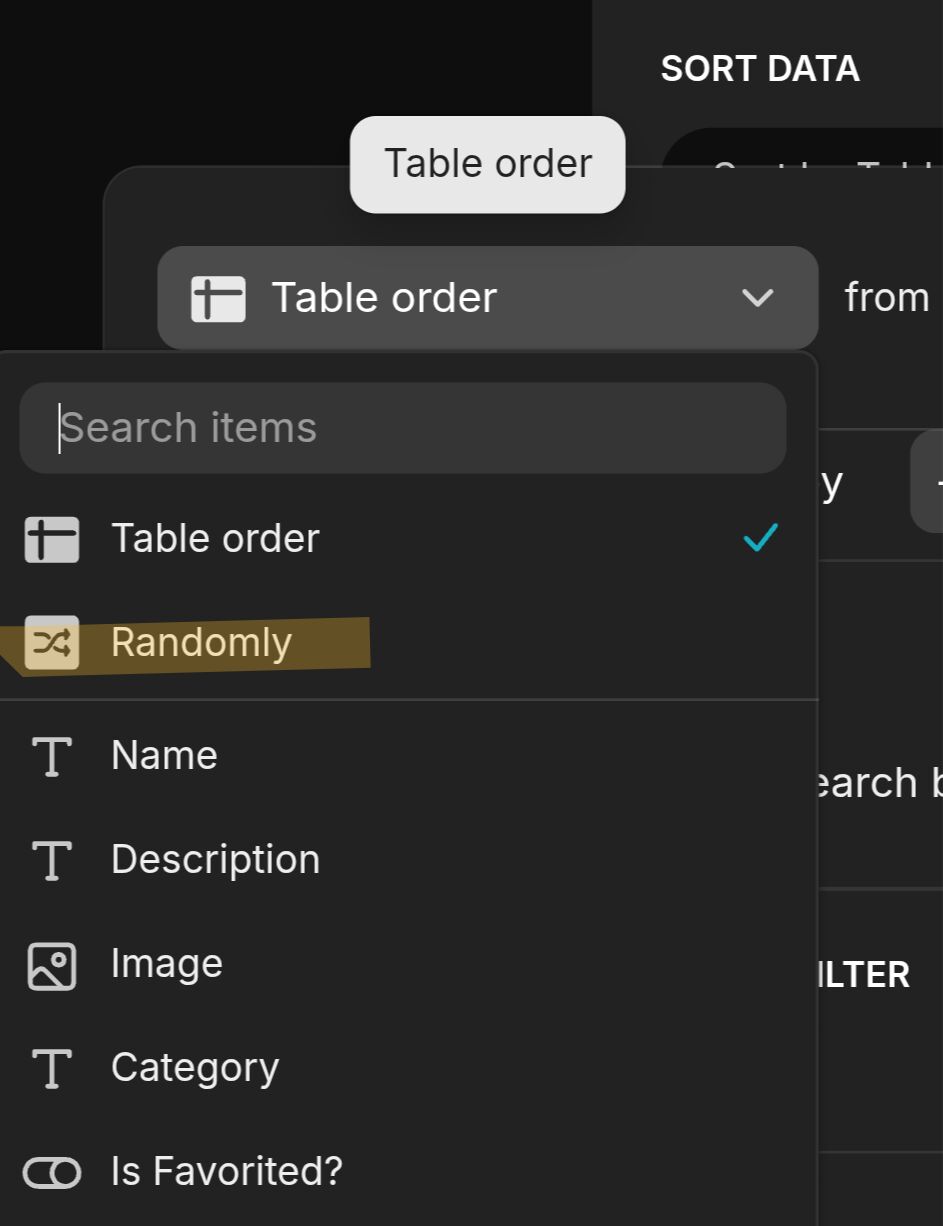
Here are three ways to show a random item from a list:
- Layout –> Collection –> Limit 1 –> Sort Random
- Data –> Single Value –> Random –> Whole Row –> Display in collection
- Data –> Single Value –> Random –> Column –> Display in a component
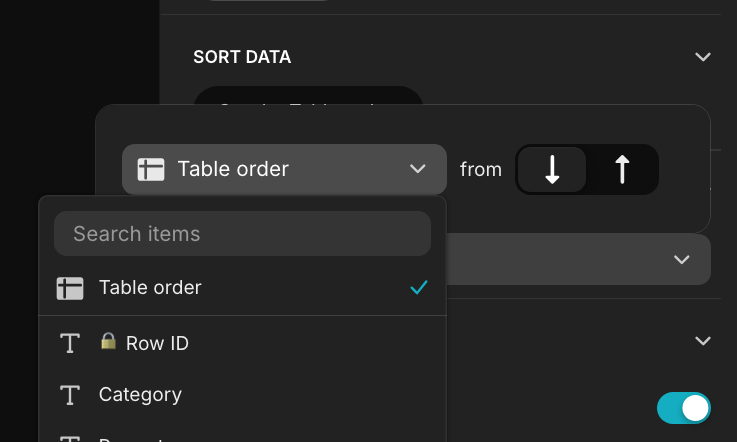

Ahh, so you are using a Big Table. That changes things. How many total rows do you expect in that table? Does it need to be a big table?
I don’t know the difference in a “Big Table” I guess. It’s currently 413 rows. And I don’t forsee it ever getting above 500, maybe 750 to be safe? There’s also 6 columns currently, and there will not be any more columns if that helps.
Big tables allow for a substantially larger number of rows, but they come with some limitations. I would create a new table and make sure it’s a regular Glide Table instead of a Glide Big Table, especially if you don’t expect more than 500 rows. That will allow you to use the random sort. You may have to export your existing data and import it into the new table, and then change your app logic to use the new table instead of the old one.
Awesome, thank you so much. I now see that some of my other tables are also Big Tables. Why would I want a Big Table over a normal table if the number of rows is not needed? Is one quicker to load than the other?
Glide says normal tables and big tables will become one at some point, but I don’t know when that will happen.
Normal tables are limited to 25k rows and can become quite slow because the entire table can be loaded on the user device. Big tables on the other hand can have millions of rows and only the data that’s needed at the moment is loaded on the user device. Big tables have a much larger reliance on server side functionality to determine which rows are needed whereas normal table do most of that client side.
One problem is that if people rely on the Glide AI Agent to build their app, it will typically default to using Big Tables because it’s a completely different infrastructure that only works with the AI Agent. Then when they try to do things that normally only work with normal tables, they run into these roadblocks or have to come up with some other workarounds.
To answer your question, yes Big Tables are typically faster because of the way they are designed to work, but the difference is negligible if the number of rows is small.
Yup. This is most likely the reason.
That’s perfect. Thanks for the response. I’ve already switched that table to a normal table and it fixed my problem! I may switch all of my others now that you explained that, too. Much appreciated!